


Showing posts with label traffic. Show all posts
Showing posts with label traffic. Show all posts
Destruction of snails in taxi advertising


France, Grenoble
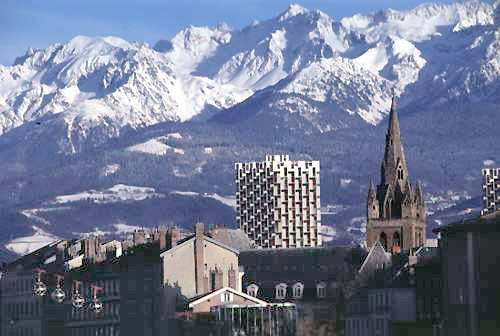
If these roads were always kept completely cleared, it was not the same for the third class roads and car parks, which were cleared with difficulty by means of rotary machines. They were made available only a few days before the Opening of the Games.
The contributions of the servise for the town of Grenoble
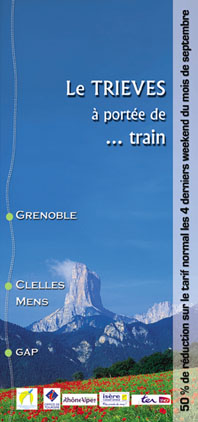
THE REYNIER-VERLAINE VIADUCT
In order to ensure service to the urban development zone, and to improve traffic conditions in the Southern part of the town, the key plan of the Urban Group of the town of GRENOBLE made by Henry BERNARD, included the building of a new East-West road, using part of the expropriations of the roads Louise MICHEL, Albert REYNIER and Paul VERLAINE, and linking the motorway B 48 (right bank of the river Drac) to the new Southern centre of the town.The town of GRENOBLE decided in 1965 to build this road which was so important for serving the Olympic Village and the Coach station. After preliminary studies, it was decided to give the new road two single direction lanes, each with three tracks, separated by a central earth platform.
GRENOBLE-VEYNES and GRENOBLE-MONTMELIAN
Crossing over the R.N. 75 (cours de la Liberation) and the railway lines S.N.C.F. GRENOBLE-VEYNES and GRENOBLE-MONTMELIAN, the new artery is continued by a construction in a straight line 540 m long which includes:— two approach slopes 107 m long to the West and 118,40 m to the East;There are, besides the liaisons with the R.N. 75, two intersections permitting exchanges with the roads BEAUMARCHAIS, Louise MICHEL, and AMPÈRE. Two underground passages for pedestrians were planned in the South part, near a densely populated zone (Paul MISTRAL district) the stadium and the BACHELARD park.
— a viaduct 102 m long crossing to the West, the cours de la Liberation and its side lanes;
— a viaduct 112,625 m long crossing to the East the railway lines and the rue Général Mangin;
— between the two viaducts a platform between the retaining walls, flanked by two slopes linking the R.N. 75 to the Eastern side of the new road.
The work was begun in July 1966 and was completed in December 1967. The total cost was 11 million Francs.
The St-ETIENNE-De-St-GEOIRS airport
THE AERODROME OF GRENOBLE-SAINT-GEOIRS
From 1938, a military aerodrome had been installed about 2 kms to the North of the town of SAINTÉTIENNE-de-SAINT-GEOIRS. This aerodrome, meant to be used to support the operations of the Alpine Army Corps, consisted of a simple flat surface of about 110 hectares which was grass covered and later on used by the Secretariat General to Civil and Commercial Aviation almost exclusively for light aviation.The geological nature of the sub-soil, which consists of layers of sand, of aluvio-glacial origin, meant that all necessary material for the construction of runways, parking zones, roads could be found on the spot.
Important savings were therefore made in the cost of these constructions.
In May 1967, after a preliminary study of expected air traffic during the Games, the decision was taken to extend the runway by 200 m to 2050 m so that it could be used by all types of middle distance aircraft including the Caravelle. In August 1967, it was judged that this airport could be usefully equipped with an I.L.S. system for landing without visibility.The important road constructions giving access to this airport should be noted, from N. 519, to avoid the difficult crossing of the town of SAINT-ÉTIENNE-de-SAINT-GEOIRS.
Approaches to ALPE-D'HUEZ
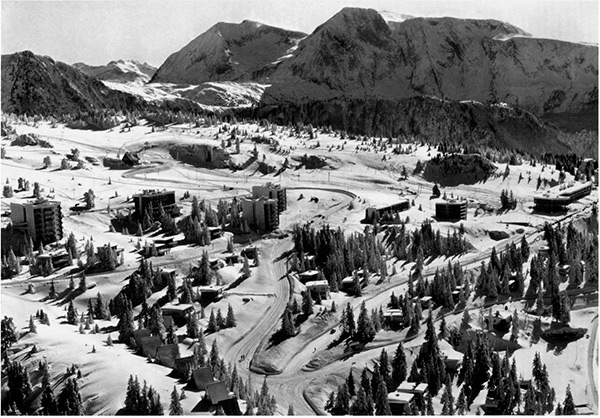
ALPE-d'HUEZ and DEUXALPES
This work may seem modest compared to the equipment installed in many foreign tourist resorts. However, it represents an important effort by the government (28,6 MF) and the authorities of the department of the Isere (46,6 MF). The latter were particularly conscious that the investment was worth while and would benefit the prestige of the resorts of Dauphiné.
The Approach Roads to the Resorts
APPROACHES TO THE VERCORS
The events taking place on the VERCORS plateau, which had always specialised in Nordic events, were located in three distinct zones.AUTRANS (33 kms from GRENOBLE) where the cross country events and 70 metres jump took place; VILLARD-de-LANS: (31 kms from GRENOBLE) where the Olympic Toboggan track was built; SAINT-NIZIER (16 kms from GRENOBLE) where the 90 metres ski jump was constructed.
The Urban Express Roads
The General Council of the Isere decided for the Olympic Games, to carry out a section 6 kms long joining the N 75 (intersection Rondeau) to the N 523 (GIÈRES road) in the form of a single roadway 10.50 metres wide, which will constitute the northern lane of the future motorway.
This express road includes two junctions and four permanent spanning constructions. During the Games, this road carried the coach traffic to and from CHAMROUSSE and ALPE-d'HUEZ as well as serving the car park and the Olympic coach station.
The cost of this work amounted to 24 million francs, of which 11 millions were paid by the government, 11 millions by the department of the Isere and 2 millions by the town of Grenoble. The work began in May 1966 and it was ready for traffic in December 1967.
All roads lead... to the Games
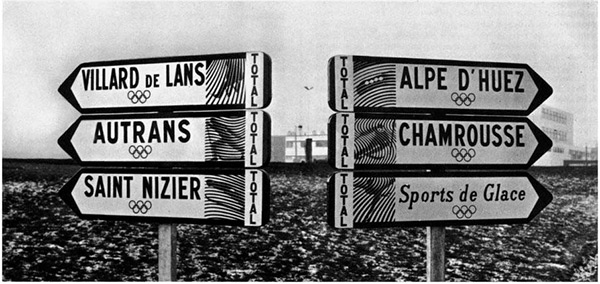
PARKING IN THE OLYMPIC RESORTS
The possibilities for parking in the Olympic stations being sometimes very limited, it was impossible to allow cars free access. Because of this, access was prohibited at CHAMROUSSE, at SAINT-NIZIER for all the events, and at AUTRANS, on 10th and 11th February, except for specially authorized vehicles. Only official vehicles were allowed to go to these resorts, and authorizations were limited to existing parking places.
The Olympic Shuttle Service
A MILLION LITRES OF PETROL
Minicoaches: 200,000 litres high-grade petrol;
Cars: 150,000 litres high-grade petrol;
Coaches: 200,000 litres diesel oil;
Military transport vehicles: 600,000 litres highgrade petrol;
Helicopters: 23,000 litres of aviation fuel;
Various machines (bulldozers etc.): 50,000 litres high-grade petrol.
Making totals of:
HIGH-GRADE PETROL: 1,000,000 litres;
DIESEL OIL: 280,000 litres;
AVIATION FUEL: 23,000 litres.
AIR TRAFFIC AT GRENOBLE SAINT-GEOIRS
The traffic for January was limited to the use of the line Paris-Grenoble by the Company Air Inter with 112 flights for 2,578 passengers. During the month of February the same company, "Air Inter" made 126 flights of which 96 were regular ones:— 12 were by Caravelle — 104 were by Viscount for a total of 6,774 passengers (arrivals and departures included).
94 charter flights by different companies were registered:
— 38 from Switzerland with 766 passengers, Oslo with 260 passengers, Frankfurt with 220 passengers, Holland with 150 passengers.
— 36 small capacity aircraft for 150 passengers.
Subscribe to:
Posts (Atom)


