Showing posts with label equipment. Show all posts

Ski Force Winter Tour 2010

Ski Force

During 4 weekends on 4 mounting skiing resorts of France (Val Thorens, Val d'Isère, Le Grand Bornand and Chamrousse) free tests of skis and snowboards of a collection of 2010 under name Ski Force Winter Tour will take place.

World leaders of mountain-skiing equipment

From November, 21st till December, 13th 2009 14 largest world marks Atomic, Elan, Dynastar, Fischer, K2, Movement, Head, Kästle, Roxy, Nordica, Rossignol, Salomon, Scott and Völk give to all wishing to test their novelties absolutely free of charge, and also to receive a good advice and consultations on the equipment is direct at representatives of the manufacturer.

Round comes to the end in the nearest days off on resort Chamrousse 1,650 (nearby to Grenoble).

Ski Force Winter Tour is the mass and extremely popular action annually uniting on mountain resorts of Europe professionals and fans of mountain skis and a snowboard. These are unique days when enthusiasts have an opportunity to familiarise and test any last models of leading world manufacturers, to exchange opinions and to receive consultations of experts absolutely free of charge.

Within the limits of Ski Force Winter Tour free lessons, competitions and draws of prizes, including skis and snowboards also are conducted.

The new pendular lift la Croix

On Chamrousse also will be free to work lift Gaboureaux that the chosen novelties could test visitors there and then without superfluous expenditure. Also this year resort Chamrousse 1,750 opens the new pendular lift la Croix which will transport to 3,000 skiers at an o'clock. Accordingly people will spend less time for lifting and to spend more time on snow.

Phenomenon RIDE

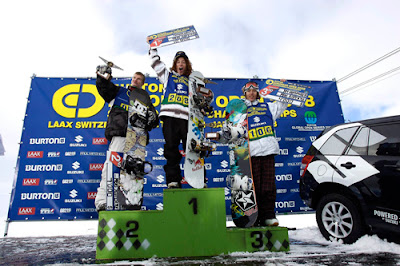
Sebastien Toutant

RIDE Snowboards confirm hearings that has come to the company surprising Sebastien Toutant.

Talented rider Sebastien Toutant

17-year-old rider from Quebec will support Ride’s International snowboard team. A miracle known under name Seb Toots, has worn to itself road on tops of ratings TTR, having won some large competitions in last season. Among them Freestyle Berlin Big Air, Freestyle. Ch. Big Air (the second place) and Burton NZ Open.
In Ride the guy have noticed, when that has flashed on Ride Shakedown — has won competitions the second year successively.

«What will this boy make next time?» — this question the manager of command Matt Sickels has decided to set with maximum a short distance. «In general he can win any competitions in which will take part. At Sebastien super-talent! To us it is pleasant, that rider will act on board RIDE!»

LEGENDARY TEAM RIDE

Sebastien Toutant too considers, that has fallen into in good hands: «Equipment RIDE is perfected to perfection. I wish to grow together with a command and a brand lifting snowboarding on the following level».

Young talent will go for a drive on boards Ride Kink 147, DH 151 and Society 151 with Contraband™ LTD, Delta and EX this winter.
And as Sebastien Toutant will go for a drive, I will necessarily inform you!

The Activity of The Technical Services of The Town of Grenoble

Town Grenoble

The organization of the Olympic Games necessitated important adaptations of the urban road systems. The work was planned and executed so that it could be integrated in the town planning and the structural schemes of the Grenoble conurbation.

The whole of this work entailed the creation of 17 kms of new roads: 47,000 metres of kerb, 34,000 metres of guttering, 300,000 square metres of surfacing, 12,000 metres of drains.
The cost of this work is about 32 million francs.

The service also collaborated in the study and drafting of specification files, the execution and financing of the equipment which was executed under the control of the Highway Department or the S.N.C.F. The town of Grenoble financed all this work which cost about 20 million francs.

THREE PROJECTS INTENDED FOR NATIONAL EDUCATION

Three projects intended for National Education were executed with the cooperation of the Technical Services and, in particular the Architectural Division.
These buildings were used for various purposes during the Olympic Games.
The total cost of these buildings was about 21 million francs.

475 ROAD SIGNS INSTALLED

The important projects were completed for the Opening of the Games, and the bye-laws concerning traffic during the Games had been approved by the Prefecture.

At the Opening of the Games, the traffic service of the town had to deal with three principal points:
— Installation of road signs on mobile supports, to publish the regulations of the municipal bye-laws.
— Supervision and repair day and night, of the traffic lights at 60 road junctions in the town of Grenoble.
— Information to the public on the traffic during the Games. 475 road signs were put in place by the end of the Games.
As a result of the organization by the Town of Grenoble, and the employment of an important police service, the traffic situation inside Grenoble was satisfactory during the Olympic period.

TEAMS ALWAYS ON CALL

The general organization of the maintenance service for the roads of the town had to be modified during the Olympic period.

Permanent duty teams, each consisting of a foreman, 8 men and 3 vehicles ensured the security service, day and night, in shifts of eight hours each. They were ready to cope with all kinds of incidents, such as snow falls, icy roads, road or pavement subsidence, oil or diesel oil on the roads after an accident, etc... These teams, put into service after 29th January 1968 worked until 19 February.

105 TONS OF HOUSE-HOLD REFUSE

During the Olympic period the Health Services of the town carried out the daily collection of the refuse of the Olympic Village and the Press Centre in hermetically sealed cans, and also the twice daily collection of refuse from the four Olympic restaurants.
This service was also carried out on Sundays.

As the Olympic Village and the Press Centre were enclosed, the dust bins had to be transported on trolleys to certain outlying points which were accessible to the vans.

Besides this a special service for the collection of cardboard boxes, and also bulky waste materials was operated every day.
The weight of all waste materials collected from the Olympic Village the Press Centre, and the 4 Olympic restaurants may be estimated at 8 tons per day.
For the period extending from 6th to 18th of February the total was about 105 tons.

THE CLEANING OF THE PUBLIC ROADS

The municipal road cleaning teams were doubled by teams from private firms. These firms took part in the cleaning every day including Sunday from 12 to 5 p.m. during all the Olympic period.
A day duty service was also carried out during this period so that a cleaning team could be sent to any place where required.

The Arhievements of The Minicipal Gas of The Town of Grenoble

French Electricity Board

For the Olympic Games, the Gas and Electricity Company of Grenoble had to guarantee the supply of electricity during the periods of preparation, and above all during the events. To do this, efforts were made on the following points.

POWER GUARANTEED IN MEDIUM VOLTAGE

The power required was concentrated in two important points:
— Paul Mistral Park
Ice Stadium — power installed: 1,600 KVA
• Speed Circuit — power installed: 1,000 KVA
• Skating Rink — power installed: 500 KVA

— South zone including
• The equipment of the Olympic Village in the Priority Development Zone (1,600 new apartments).
• The equipment of the Press Centre in the Malherbe district.

NEW DISTRIBUTION NETWORK

The creation of the Olympic Village and Press Centre districts for the Games, led the Company to construct a complete network including medium voltage, low voltage, public lighting and remote control. The company, in complete charge of this work, was responsible for the execution or supervision of the new installations.

Were put into service in September 1967:
— 20 prefabricated posts, with a total power of 5000 kVA.
— 64 metres of Cables MV or LV of different sections.
This work cost about 2 million francs.

A distributor post with double supply and overall metre system permitted operations in safety. For the period from 1st January 1968 to 29th February 1968, the total energy provided for the Games was about 2,500,000 kilowatt-hours.

For the illuminations and various shows, two hundred boxes or terminals operated by remote control were installed in the different important roads of the town.
From 4th to 18th February, 60 of the representatives of the Electricity Company were on duty at the critical points to ensure the supply of current. During this period there were no incidents.

THE IMPROVEMENT OF PUBLIC LIGHTING

The number of lights increased from 6,835 on 1st January 1967 to 10,212 on 1st January 1968, representing a power of 2,100 KV. The principal roads of the town were equipped with balloon-type fluorescent lamps, of 400, 700 or 1,000 watts. Posts 14 and 16 metres high, equipped with 6 lamps of 700 or 1,000 watts were used to light large spaces.

The intensity of light on the ground, although fairly uniform throughout the town, was increased to 25, 45 or 60 lux, at certain places on the important arteries.
Also, for the Olympic Games, an effort was made for particular illuminations. All the sculptures of the International Symposium of August 1967, as well as the façades of the churches of Saint-Laurent and Saint-Louis were appropriately illuminated.

GAS

The work carried out for the Olympic Games can be classed in two categories:
— the complete equipment of a zone where no housing existed before the Games (Priority Urban Development Zone, MALHERBE);
— work due to the modification of the roads and railways (flyovers or underground passages, widening new roads, etc...).
The work of the first category concerned a group of buildings which contained about 2.200 apartments, intended for the use of the population of Grenoble after the Games.

The Company was therefore obliged to undertake, in this zone of 65 hectares, important equipment installations which had to be completed in one year. 10 kms of medium and low pressure canalisations, from 100 to 250 mm in diameter, were laid, and also 180 service pipes 40 to 80 mm in diameter: a gas pressure reducer of a nominal capacity of 3,000 m3 per hour was also built.

The works in the second category, were spread over several parts of the town.
All this work was carried out, using new techniques, and taking into account that natural gas will be available in Grenoble about 1972, and taking care to ensure the continuity of distribution with maximum security and regularity.

The whole of this work, costing 2,400,000 F. required the laying of 20,800 metres of pipes of diameters 40 to 350 mm. So, in the field of Gas and Electricity the Grenoble Company was able to satisfy all demands, often in difficult conditions as the time available was limited and important sums of money had to be invested, over and above the normal programme.

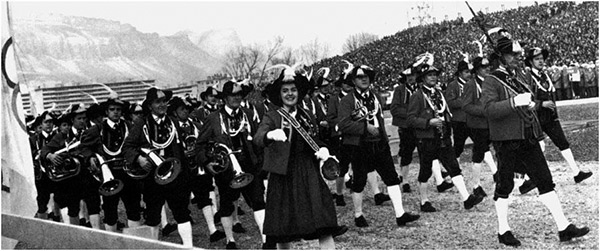
The Austrian Tyrol comes to Dauphiné

Austrian Tyrol

The expenses for the installation of projectors were shared between Electricity of France, COJO and the Municipalities concerned:
— So, in the Oisans, the church towers of the following villages were illuminated at night-fall.
— LA GARDE and HUEZ, villages perched on the mountain side, and situated on the beautiful route leading to the Olympic resort of Alpe d'Huez.
— LE FRENEY-D'OISANS, in the deep valley of the Romanche.
— MIZOEN, from where the admirable site of the Chambon lake can be seen.
— MONT-DE-LANS, on the other side of the valley from MIZOEN, above the dam of Chambon, a picturesque village on the route which leads to the resort of DEUX-ALPES.
— LA GRAVE, opposite the glaciers of the «Massif de la Meije».
— VILLARD-D'ARÈNE, finally, at an altitude of 1,650 metres is the last locality on the road of the Passes of Lautaret and Galibier.
— Further North, in the valley of Gresivaudan, near the Isere, the little town of La TERRASSE.
— On one of the roads leading to the Olympic resort of Chamrousse, VAULNAVEYS-LE-HAUT, with its fifteenth century church tower.
— To the South of Grenoble, the Church at Vif whose square Norman tower has kept its twelfth century structure.
— In the Vercors, as well as the tower of the little church of Saint-Nizier du Moucherotte, which miraculously escaped the destruction of the village in 1944, the Memorial of the Pioneers of the Vercors, erected to the memory of the Resistance heroes, killed in the bitter fighting of the Liberation, was also illuminated on the slope overlooking Grenoble.
— Finally, from the top of the 2,200 m. Cross of Chamrousse, a powerful luminous signal, threw its beam towards Grenoble, recalling the presence there of the great Olympic resort.
Another, less spectacular participation, which was greatly appreciated by the motorists taking the difficult road of Lautaret, was the lighting, in collaboration with the Highway Department of the Hautes-Alpes, of the three road tunnels, the passage of which is known to be very difficult, by day as well as by night.

THE «TROIS PUCELLES» CLIFFS ILLUMINATED

Finally, a prestige achievement, dedicated to the Mountain, to the Olympic Games, and to the hardy pioneers, who made Grenoble the cradle of «white coal»; the spectacular illumination of the «Trois Pucelles» Cliffs.

This rock which marks, with the snow capped ridge of the Moucherotte, 1,900 metres high, the first spur of the Massif of the Vercors, dominates Grenoble and overlooks the immense Stadium of the Olympic Ski-jump, not far from Saint-Nizier du Moucherotte.

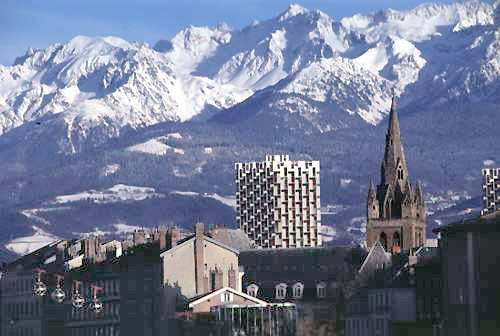
France, Grenoble

France, Grenoble

In fact, all this material was in frequent use, not during the Olympic period, as no important snow fall took place, but during the preceding month. Very heavy continuous snow falls (altogether several metres thick) took place from the end of December, and the material and personnel only just available, were sorely tried while still training.

If these roads were always kept completely cleared, it was not the same for the third class roads and car parks, which were cleared with difficulty by means of rotary machines. They were made available only a few days before the Opening of the Games.

The contributions of the servise for the town of Grenoble

Travel map, Grenoble

THE REYNIER-VERLAINE VIADUCT

In order to ensure service to the urban development zone, and to improve traffic conditions in the Southern part of the town, the key plan of the Urban Group of the town of GRENOBLE made by Henry BERNARD, included the building of a new East-West road, using part of the expropriations of the roads Louise MICHEL, Albert REYNIER and Paul VERLAINE, and linking the motorway B 48 (right bank of the river Drac) to the new Southern centre of the town.

The town of GRENOBLE decided in 1965 to build this road which was so important for serving the Olympic Village and the Coach station. After preliminary studies, it was decided to give the new road two single direction lanes, each with three tracks, separated by a central earth platform.

GRENOBLE-VEYNES and GRENOBLE-MONTMELIAN

Crossing over the R.N. 75 (cours de la Liberation) and the railway lines S.N.C.F. GRENOBLE-VEYNES and GRENOBLE-MONTMELIAN, the new artery is continued by a construction in a straight line 540 m long which includes:
— two approach slopes 107 m long to the West and 118,40 m to the East;
— a viaduct 102 m long crossing to the West, the cours de la Liberation and its side lanes;
— a viaduct 112,625 m long crossing to the East the railway lines and the rue Général Mangin;
— between the two viaducts a platform between the retaining walls, flanked by two slopes linking the R.N. 75 to the Eastern side of the new road.
There are, besides the liaisons with the R.N. 75, two intersections permitting exchanges with the roads BEAUMARCHAIS, Louise MICHEL, and AMPÈRE. Two underground passages for pedestrians were planned in the South part, near a densely populated zone (Paul MISTRAL district) the stadium and the BACHELARD park.

The work was begun in July 1966 and was completed in December 1967. The total cost was 11 million Francs.

New skilifts at Chamrousse

Marielle Goitschel

The Equipment Service was entrusted with the control of the plans, and also the direction of the construction of six new ski-lifts at Chamrousse during the preparation of the Olympic Games. In order to keep the ground clear as much as possible for skiing, all were two seater chairlifts, permanently fixed to the cable and capable of transporting 720 skiers per hour.

Four of these skilifts were directly implicated in the organization of the Olympic Games:

— the chairlift of GABOUREAUX (vertical drop 525 m) replaced the skilift of the same name, which was removed to permit the equipment of the finishing stadium;
— the chairlift of the Col de la Balme (vertical drop 190 m) served the slalom training zone as well as the access to the lower half of the Men's Downhill trail;
— the Vallons chairlift (vertical drop 380 m) served the greater part of the giant slalom trails, and the Ladie's Downhill run;
— the chairlift of Lake Robert (vertical drop 250 m) served the slalom training zone; unlike the three former chairlifts which started from the Recoin, it extended North of the Cross of CHAMROUSSE, the skiing ground of the resort.
This equipment, costing altogether 2,600,000 F was financed by the Department of the Isère and subsidised, 80% for the first and 50% for the three others, by the Ministry for Youth and Sport.

MONTAZ and MAUTINO

The first two built respectively by the firms S.A.C.M.I. and MONTAZ and MAUTINO, were put into service in December 1965. The two others were built by the firms POMAGALSKI and MONTAZ MAUTINO and were put into service in November 1966.

The Department of the Isère wished to develop that part of the skiing area not occupied by the Olympic trails, and financed, with 1,600,000 F, the building of two chairlifts starting from ROCHE-BÉRANGER:
— the chairlift of the Perche (Vertical drop 380 m) put into service in November 1966;
— the chairlift of the Achard Lakes (vertical drop 320 m) put into service in November 1967. These two were built by POMAGALSKI.

Chamrousse trails

Downhill run

The traditional trails of the resort were largely used for the men's and women's Downhill Race, as their general characteristics seemed satisfactory. It was however necessary to calibrate them, to get rid of bottle necks, and rock steps, to blow up rock masses, to cut down trees, etc...

Some particular points demanded more important work:
— in the upper third of the Men's Downhill, two rocky ridges were split up to vary the tracing, just after the shoulder of the "Grand Couloir", and at the branch of "Arbre Mort". Another ridge was cut at the beginning of the "false plateau" called "des Grottes", and the "Couloir KRIEG" was banked up.
— on the Women's Downhill trail, a rocky ridge was split up at the start of the "Grand Couloir", and the "Arbre Mort" bend was completely remodelled. An embankment of 12,000 m3 was made at the Vernon stream, to limit the length of a "false plateau" before the finishing schuss.

Slalom

The slopes necessary for the organization of a special slalom must present relatively stiff characteristics and the equipment of a slalom stadium in the immediate proximity of the finishing zone required very important earth works; the natural terrain was in fact cut by a deep ravine, which had to be filled in, and marked by two rocky ridges which were blasted.

More than 200,000 m3 of rock embankment had been made before the International Weeks. During these events, the summit zone of the Men's special slalom was judged to be still too flat and a starting hillock, 20 m High (35,000 m3 of rocky material) was heaped at the summit of this trail during the summer of 1967.

The work begun in July 1967 was completed in three months. It was financed by the Department of the Isère, which received a grant of 80% from the Ministry for Youth and Sport. It amounted to 4,400,000 F.

Chamrousse Slalom Trails