Showing posts with label CHAMROUSSE. Show all posts

Ski Force Winter Tour 2010

Ski Force

During 4 weekends on 4 mounting skiing resorts of France (Val Thorens, Val d'Isère, Le Grand Bornand and Chamrousse) free tests of skis and snowboards of a collection of 2010 under name Ski Force Winter Tour will take place.

World leaders of mountain-skiing equipment

From November, 21st till December, 13th 2009 14 largest world marks Atomic, Elan, Dynastar, Fischer, K2, Movement, Head, Kästle, Roxy, Nordica, Rossignol, Salomon, Scott and Völk give to all wishing to test their novelties absolutely free of charge, and also to receive a good advice and consultations on the equipment is direct at representatives of the manufacturer.

Round comes to the end in the nearest days off on resort Chamrousse 1,650 (nearby to Grenoble).

Ski Force Winter Tour is the mass and extremely popular action annually uniting on mountain resorts of Europe professionals and fans of mountain skis and a snowboard. These are unique days when enthusiasts have an opportunity to familiarise and test any last models of leading world manufacturers, to exchange opinions and to receive consultations of experts absolutely free of charge.

Within the limits of Ski Force Winter Tour free lessons, competitions and draws of prizes, including skis and snowboards also are conducted.

The new pendular lift la Croix

On Chamrousse also will be free to work lift Gaboureaux that the chosen novelties could test visitors there and then without superfluous expenditure. Also this year resort Chamrousse 1,750 opens the new pendular lift la Croix which will transport to 3,000 skiers at an o'clock. Accordingly people will spend less time for lifting and to spend more time on snow.

New skilifts at Chamrousse

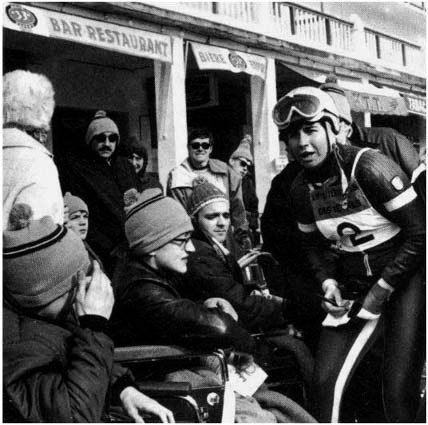
Marielle Goitschel

The Equipment Service was entrusted with the control of the plans, and also the direction of the construction of six new ski-lifts at Chamrousse during the preparation of the Olympic Games. In order to keep the ground clear as much as possible for skiing, all were two seater chairlifts, permanently fixed to the cable and capable of transporting 720 skiers per hour.

Four of these skilifts were directly implicated in the organization of the Olympic Games:

— the chairlift of GABOUREAUX (vertical drop 525 m) replaced the skilift of the same name, which was removed to permit the equipment of the finishing stadium;
— the chairlift of the Col de la Balme (vertical drop 190 m) served the slalom training zone as well as the access to the lower half of the Men's Downhill trail;
— the Vallons chairlift (vertical drop 380 m) served the greater part of the giant slalom trails, and the Ladie's Downhill run;
— the chairlift of Lake Robert (vertical drop 250 m) served the slalom training zone; unlike the three former chairlifts which started from the Recoin, it extended North of the Cross of CHAMROUSSE, the skiing ground of the resort.
This equipment, costing altogether 2,600,000 F was financed by the Department of the Isère and subsidised, 80% for the first and 50% for the three others, by the Ministry for Youth and Sport.

MONTAZ and MAUTINO

The first two built respectively by the firms S.A.C.M.I. and MONTAZ and MAUTINO, were put into service in December 1965. The two others were built by the firms POMAGALSKI and MONTAZ MAUTINO and were put into service in November 1966.

The Department of the Isère wished to develop that part of the skiing area not occupied by the Olympic trails, and financed, with 1,600,000 F, the building of two chairlifts starting from ROCHE-BÉRANGER:
— the chairlift of the Perche (Vertical drop 380 m) put into service in November 1966;
— the chairlift of the Achard Lakes (vertical drop 320 m) put into service in November 1967. These two were built by POMAGALSKI.

Chamrousse trails

Downhill run

The traditional trails of the resort were largely used for the men's and women's Downhill Race, as their general characteristics seemed satisfactory. It was however necessary to calibrate them, to get rid of bottle necks, and rock steps, to blow up rock masses, to cut down trees, etc...

Some particular points demanded more important work:
— in the upper third of the Men's Downhill, two rocky ridges were split up to vary the tracing, just after the shoulder of the "Grand Couloir", and at the branch of "Arbre Mort". Another ridge was cut at the beginning of the "false plateau" called "des Grottes", and the "Couloir KRIEG" was banked up.
— on the Women's Downhill trail, a rocky ridge was split up at the start of the "Grand Couloir", and the "Arbre Mort" bend was completely remodelled. An embankment of 12,000 m3 was made at the Vernon stream, to limit the length of a "false plateau" before the finishing schuss.

Slalom

The slopes necessary for the organization of a special slalom must present relatively stiff characteristics and the equipment of a slalom stadium in the immediate proximity of the finishing zone required very important earth works; the natural terrain was in fact cut by a deep ravine, which had to be filled in, and marked by two rocky ridges which were blasted.

More than 200,000 m3 of rock embankment had been made before the International Weeks. During these events, the summit zone of the Men's special slalom was judged to be still too flat and a starting hillock, 20 m High (35,000 m3 of rocky material) was heaped at the summit of this trail during the summer of 1967.

The work begun in July 1967 was completed in three months. It was financed by the Department of the Isère, which received a grant of 80% from the Ministry for Youth and Sport. It amounted to 4,400,000 F.

Chamrousse Slalom Trails

Snow fun in Chamrousse

NON-STOP CIRCULAR COACH SERVICE

For the events at CHAMROUSSE, AUTRANS and SAINT-NIZIER, certain sections of the road were converted for one-way traffic, as the road network allowed the return journey by another route. This meant that the empty 'buses could wait by the roadside until the spectators returned, and also that other vehicles could overtake, even without visibility. This greatly improved traffic conditions.

On 18th February about 150 'buses were able to make two round trips to Saint-Nizier. The transport of spectators is resumed in the following table, with, in the other column, the details of the busiest day (18th February).