


National Federation of Road Transport
The transport service of the Organizing Committee attached to the technical department, was created on 1st March 1966. However, from 1964 contacts had been made by the Committee with the National Federation of Road Transport for the transport of spectators and with the Renault National company for the transport of officials. Besides this, the general principles of the itineraries, the regulation of traffic and the establishment of most of the bus stations had been defined since that date.The structure of the service was as follows: Besides the Head of the Service and his Secretariat, specialised sections had been created for the transport of spectators, transport of material (military transport), the vehicle licensing office, the traffic office, ground organisation, road signs. During the games, 3,000 people worked on strictly Olympic transport.
The administrations concerned by transport were numerous. The importance of the work of coordination which was carried out under the authority of the Prefect of Isere with the cooperation of B.C.E.O.M. must be stressed.
Official Olympic Transport
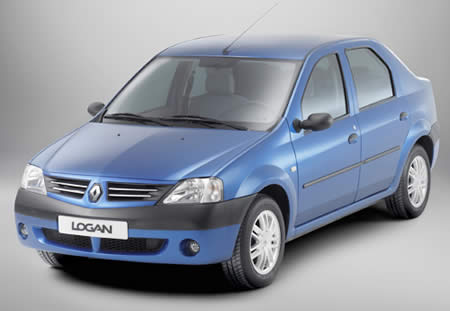
400 CARS, 500 MINICOACHESThe general term "official transport" includes the transport of officials, athletes, organization personnel, journalists and the personnel of certain firms under contract. The Organising Committee had at its permanent disposal: 3 Renault Ramblers — 210 Renault 16 — 190 Renault 4 — 500 Renault minicoaches with 7 and 8 seats — 10 Berliet coaches and 6 Saviem coaches with 45 seats.
60 to 120 45-seater coaches were taken on some days from the Transolympe Coach Station to transport spectators wherever needed. The driving of these cars (R16 and R4) was the responsibility of the C.R.S. Brigade and the minicoachs were driven by the police.
The army had put 8 light helicopters "Alouette II and III" at the disposal of the Committee for the rapid transport of people, material or films (Press). A regulation office, in charge of each coach station, received requests for transport and arranged the journeys with the local headquarters of the drivers, Police or C.R.S.: in case of need reinforcements could be ordered from the Grenoble station.
Two transport offices, one at the principal reception centre, another at Grenoble railway station, could also receive requests for transport. A certain number of vehicles were also allocated to the I.O.C. and to the International Federations and to the N.O.C.
Generally, in all resorts, all the teams (with the exception of the very small ones) had at least a minicoach at their disposal. At Autrans, the nations who had ski-jumpers had the use of a supplementary minicoach to facilitate the transfer of these competitors to St-Nizier.
For Grenoble, the arrangements were different because of the regular shuttle service which had been set up and also the importance of the hockey teams' equipment. The speed skating and figure skating competitors used these services which ran every five minutes between the Olympic village and the events. Each hockey team had permanent use of a 'bus. Altogether 500 minicoach were distributed as follows.

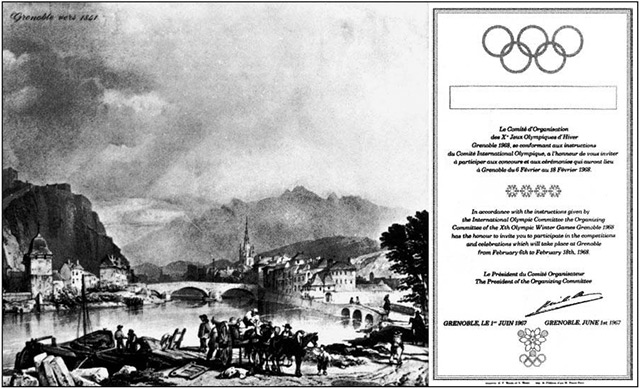
 The idea of Grenoble's application was not put forward without due thought: the originators were the Prefect of the Isère in office at the time, Mr. François RAOUL and Mr. Raoul ARDUIN, at the time President of the Dauphiné Ski Committee, a branch of the .
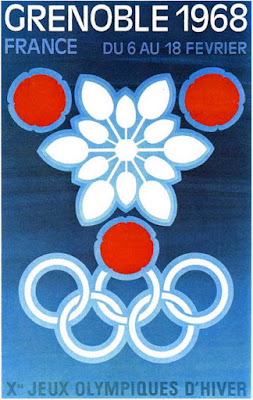 On December 30th, 1960, Dr. MICHALLON officially informed the President of the of Grenoble's application for the Xth Winter Olympic Games. In his letter, Dr. MICHALLON stressed that the Dauphiné was applying for the honour of organizing the Games because "the region has many large modern winter sports resorts of world-wide repute" and "Grenoble, now an urban centre of more than 200,000 inhabitants, constantly progressing demographically and economically, has the great privilege of its situation in the geographical centre of a region traditionally renowned for sport, and equipped with enough basic installations to facilitate such an undertaking".
 French Olympic Committee
 Athletic Associations/Organizations, Unions of Olympic Committees (Est. 1995)


